top of page
Modular framework for underwater construction
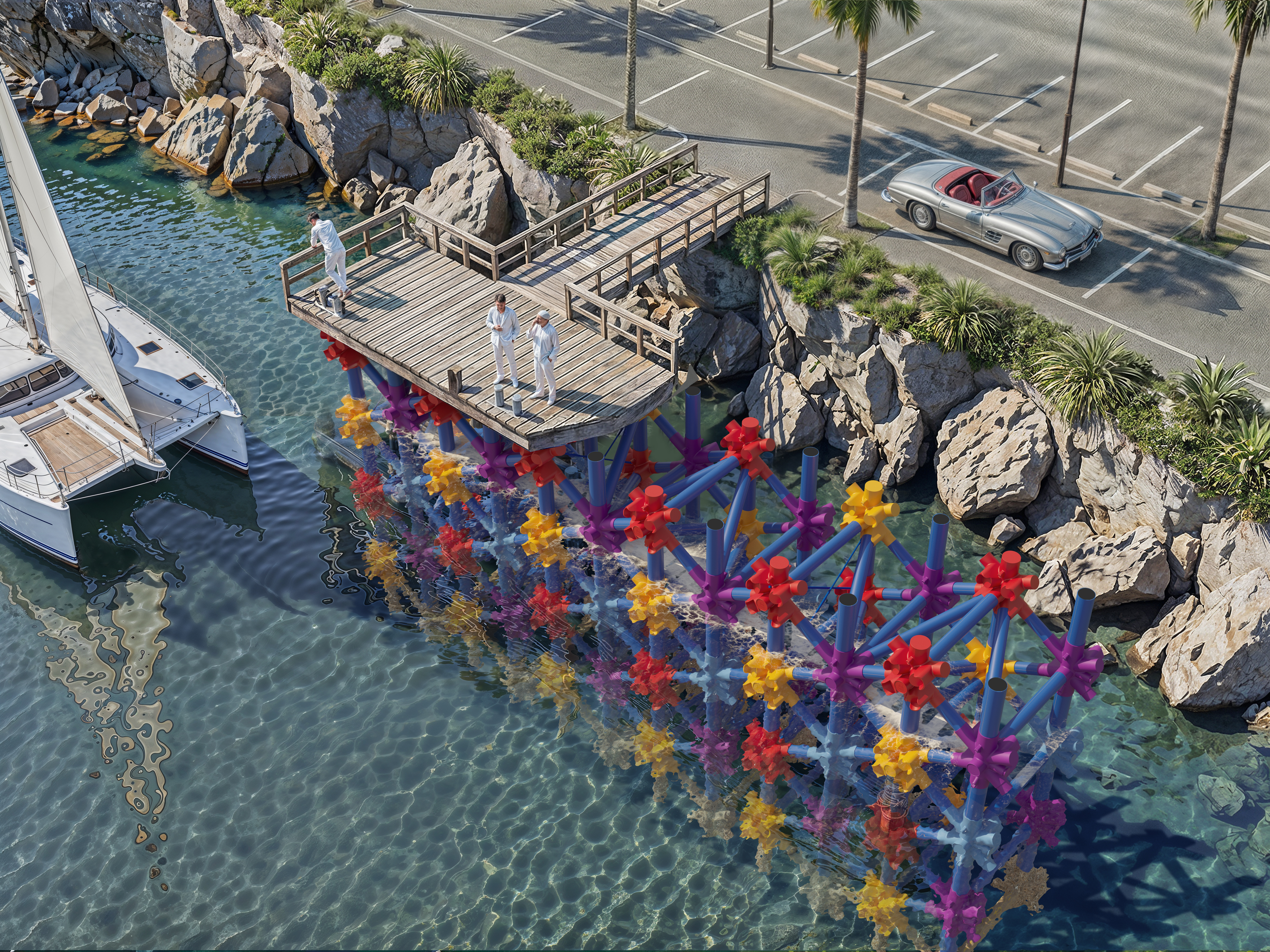
Drawing of concrete modular framework

ADVANCED
MARINE CONSTRUCTION
TECHNOLOGY

Building a Sustainable Future


HYDRANTULA

Modular framework for underwater construction

What is HYDRANTULA?

Hydrantula PTE LTD is a Singapore-based deep-tech company specialising in modular coastal protection infrastructure designed for long-term deployment in marine environments. The company holds the intellectual property rights to the Hydrantula coastal technology platform - a system of engineered structural components combining high-density polyethylene (HDPE) shells, steel-reinforced concrete (SRC) cores, and glass- and basalt-fibre-reinforced polymer (GFRP) rebar, designed to deliver a service life exceeding 50 years in corrosive seawater conditions.

The platform addresses the growing global demand for scalable, durable and nature-compatible coastal flood protection, combining engineering robustness with a reduced environmental footprint compared to conventional concrete or steel sea defence structures. Hydrantula solutions are applicable to shoreline stabilisation, wave attenuation, port and harbour protection, and adaptation of coastal urban infrastructure to rising sea levels and increased storm surge frequency.

Hydrantula is currently commercialising its technology in Singapore and is actively pursuing deployment opportunities in coastal markets across Southeast Asia and the United States (California). The company brings together expertise in structural and marine engineering, composite materials, regulatory compliance, and project development across tropical and temperate coastal environments.

COASTAL PROTECTION

A retaining wall (seawall) is used to armour the coastline from the destructive effects of waves, tides and storms. As a rule, the base of the structure is located below the minimum low tide level, and the upper part is above the maximum high tide level, allowing it to effectively protect the coast from regular and extreme storm impacts. Such structures are often used to stabilise coastal slopes, protect artificial embankments, and prevent shore erosion by sea waves and surface runoff. The minimum height of a seawall is usually 2 meters or more.


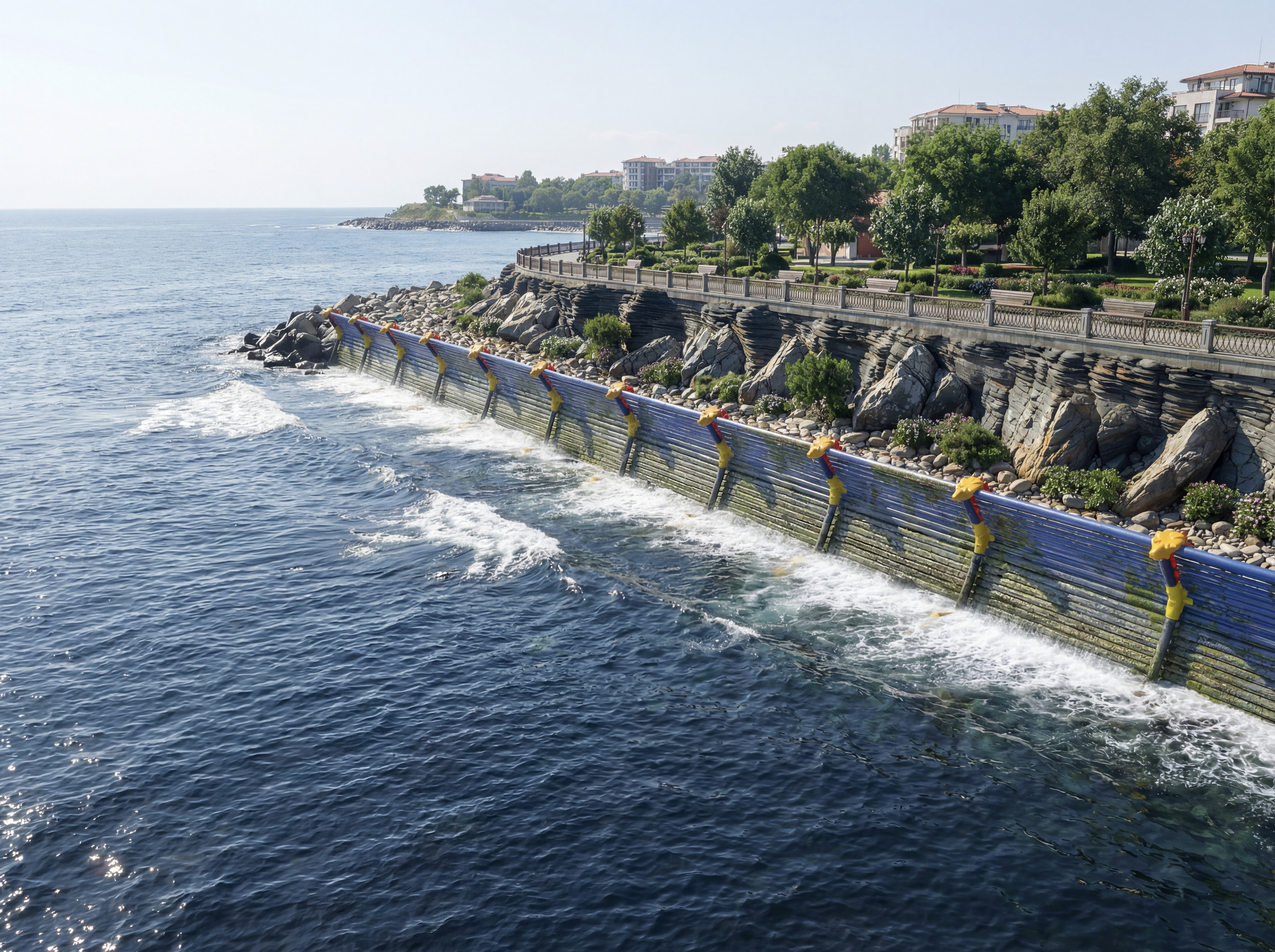
Hydrantula designs allow you to create different types of retaining walls - vertical (Z61, G41+G42) and inclined (U60), single-tier (U60) and multi-tier (U45). Depending on the conditions of the aquatoria, the wall can have a bottom shelf (U60, X6) to reduce the effect of the "washout funnel" or be installed directly on a pebble/rock seabed (G41). The space between the structure and the shore is used for backfilling with rock (U45, Z61, U60). Or the internal volume of the structure serves as a container for rock ballast (X6, G41+G42). The wide assortment of Hydrantula greatly simplifies the construction of protective structures and their adaptation to hydrological conditions.

Retention Wall - Seawall

Hydrantula Coastal Protection Seawall
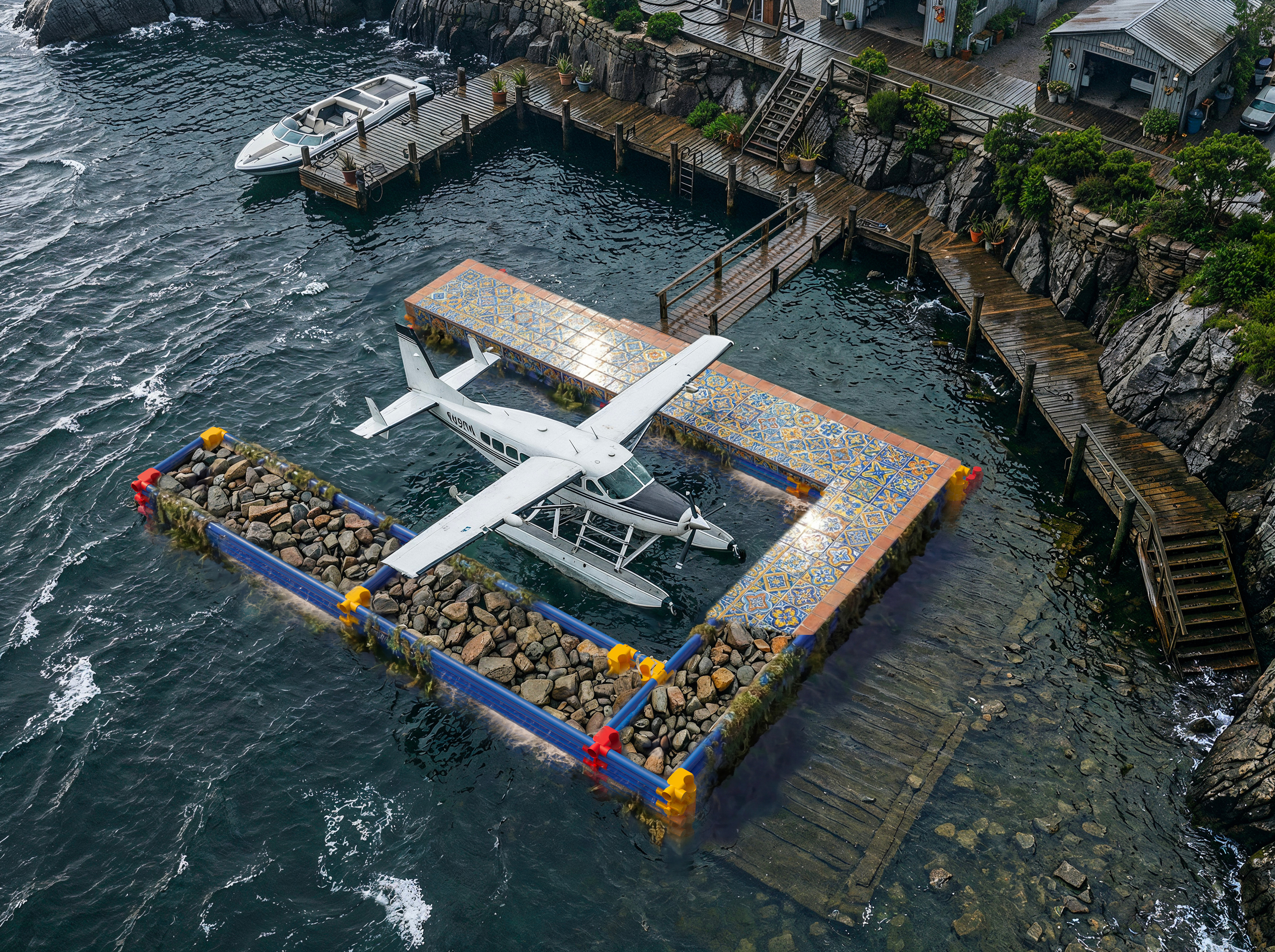
Hydrantula Sea Gabion

In some cases, using large quantities of plastic structures may be undesirable - for example, in historical or protected landscape areas. For these conditions, HYDRANTULA offers marine gabion solutions.

Sea Gabbio is a system of composite lattice containers formed by G41 and G42 fittings. The interior of the structure is filled with boulders and rubble, which provide the necessary mass and permeability. These gabions can serve as retaining walls, breakwaters, or service structures for small vessels, while maintaining a more natural appearance for the marine façade.

Sea Gabbio

In many regions of the world, coastlines have already been significantly altered by urbanisation, port construction, and rising sea levels. Under these conditions, preserving natural beaches becomes virtually impossible. Even regular sand reclamation or importation often produces only short-term results and requires ongoing investment.

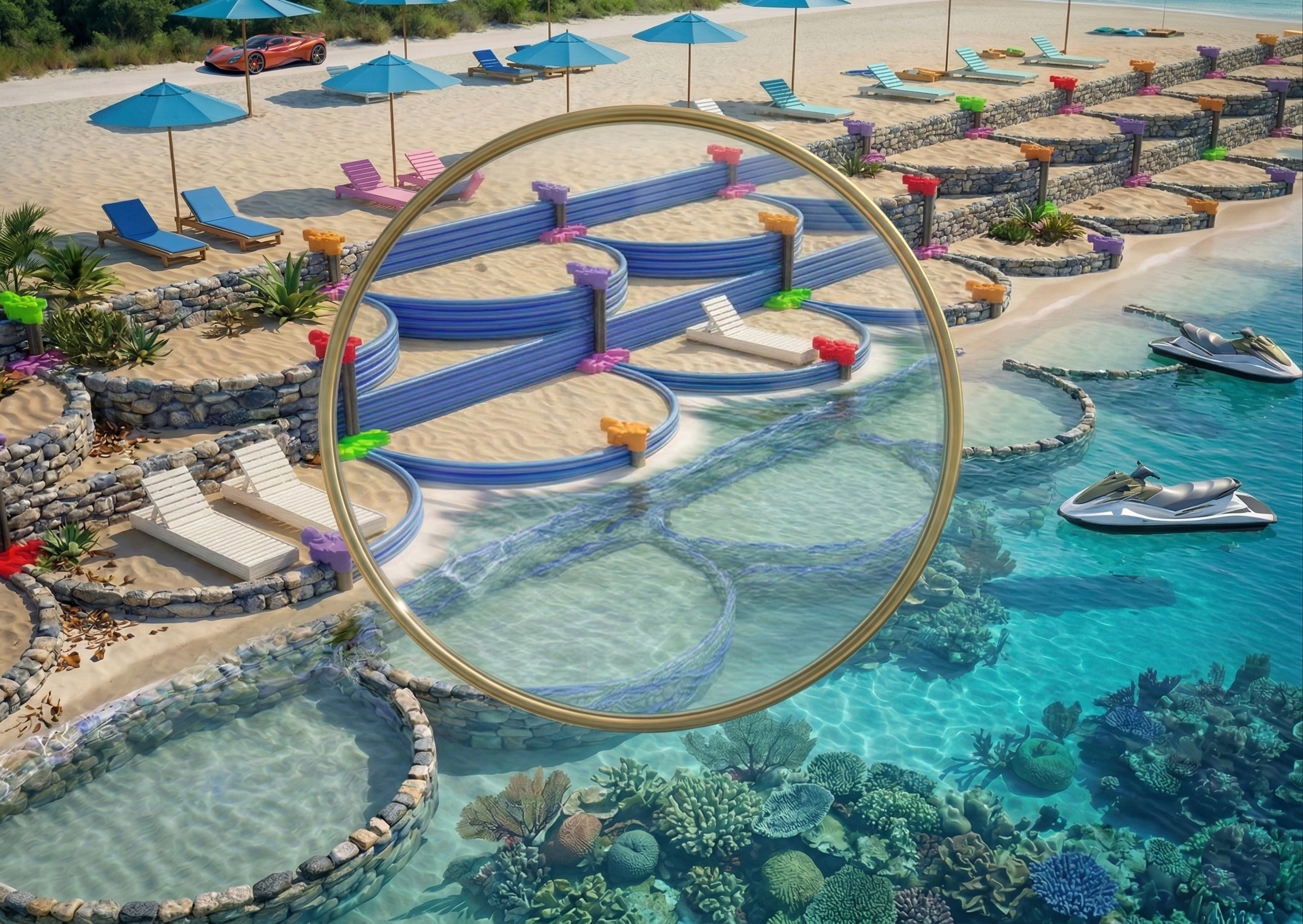
To address this problem, HYDRANTULA developed a terraced beach system based on X31 and X32 fittings. The design creates cascading sand-retaining layers that stabilise the beach and dramatically slow the removal of sand into deeper waters. The terraced structure smoothly distributes wave energy between the layers, creating a stable beach geometry. This approach allows for the creation of durable beach areas even under intense wave loads.

Terraced Beach

Terraced Dunes for sandy Beaches
Hydrantula Sea Groynes

Groynes (coastal spurs) are specialised marine structures installed perpendicular to the coastline. Their task is to intercept and fix sand masses moving along the coast by coastal currents. Thanks to groynes, sand leakage from the coastal area is significantly reduced, and the width of the beach is increased locally.


According to the principle of operation, groynes are close to insulating breakwaters, but their orientation relative to the shore makes it possible to effectively control the along-shore transport of sediments. The structures can be linear, L- or T-shaped, depending on the local hydrodynamics. In addition to the fittings mentioned above, Hydrantula recommends specialized X11 fittings for groynes. 

Groynes

A breakwater is a marine engineering structure extended into the aquatoria and designed to dissipate the energy of sea waves. The main task of the breakwater is to reduce the impact of storm waves on the coastline and reduce the intensity of coastal erosion. Depending on the structure's configuration, the breakwater can completely insulate the lagoon from the water body or act as a partially permeable barrier.


Hydrantula permeable breakwaters generate intense turbulence in the water flow. With a sharp decrease in wave speed, sand falls out of suspension in water- the so-called Dune effect. As a result, sand deposits form quickly around the breakwater, especially in the protected area behind it, and they also stabilise the shore. Structures can be permeable (X8, partially G41/G42 or X20) or impermeable (X6, U60), vertical (X6, G41/G42) or inclined (U60). Breakwaters can also have a bottom shelf (X8, X6, U60) and form a straight (G41/G42, U60, X6) or a wave-like front of interaction with waves (X8, X20).

Wavebreaker

Hydrantula Seawall Wavebreaker
Hydrantula Wavebreaker

Sandpads are artificial islets or platforms located in shallow water and partially stay above sea level. Their main task is to break waves and create sand accumulation zones, to form new beach spaces.


SandPad designs allow you to create a beach even in places where it did not exist before. Due to changes in local hydrodynamics, such islets cause sand deposition and the formation of stable sandbanks. 

Hydrantula has developed X20 fittings to create such structures. Over time, a natural shoal may form around the SandPad.

SandPad

Grey color background

What if you could build marine infrastructure...

* All references to construction speed, cost efficiency, material quantities, service life, and comparative performance are indicative, illustrative and non-binding.
Final values can only be determined through project-specific engineering analysis, detailed design, and formal technical and commercial evaluation.

Grey color background

01

...faster than conventional marine construction

What if marine structures could be delivered up to 4 times faster than even the most efficient conventional offshore construction methods? This acceleration is achieved by shifting the majority of construction activities away from the marine environment. In typical projects, up to 90% of all assembly work is carried out on land, under controlled conditions. As a result, offshore operations are reduced to installation and final structural integration, significantly shortening construction timelines and minimising weather dependency.


Drawing of modular framework for coastal protection
Grey color background

02

...more cost-efficient by design

What if marine construction could be at least 3 times more cost-efficient than the most economical, reliable alternatives available today? HYDRANTULA structures are designed to use material only where it is structurally effective. For example, a marine wall with a length of 100 meters, a height of 6 meters and a width of 3 meters can be realised with approximately 100 cubic meters of concrete, rather than massive solid volumes. This material efficiency directly translates into lower construction, transport and installation costs.


Drawing of concrete modular framework
Grey color background

03

...more durable,
resilient and serviceable

What if marine structures could be engineered for a guaranteed operational life of at least 60 years, with inherent resistance to harsh marine environments and extreme natural conditions? HYDRANTULA structures are conceived as long-life infrastructure elements that are repairable, maintainable and, where necessary, replaceable. Their assembly does not rely on complex offshore machinery or highly specialised marine crews, which simplifies long-term operation and lifecycle management.


Drawing of concrete modular framework
Grey color background

04

...modular like a construction set

What if a limited set of modular elements could address up to 90% of typical marine construction needs? By combining more than 40 standardised structural fittings, HYDRANTULA enables the creation of a wide variety of spatial configurations. The system works conceptually like a construction set, allowing designers and engineers to adapt structures to site-specific requirements without developing bespoke solutions for every project.


Drawing of concrete modular framework

HYDRANTULA is designed for a broad range of coastal and marine applications, particularly in shallow and mid-depth waters.
 

Typical use cases include:

  • Private and public piers, jetties and access platforms

  • Nearshore beaches and waterfront developments

  • Small and medium-scale marine terminals and berthing structures

  • Coastal protection systems and wave-attenuation structures

  • Expansion and stabilization of reclaimed or artificial land

  • Flood-protection and shoreline reinforcement infrastructure
     

The modular character of the system allows structures to be scaled from small private installations to large civil infrastructure projects. HYDRANTULA can be deployed as a standalone structural solution or integrated into hybrid coastal systems combining engineered and nature-based elements.

 
IMG_3085.jpg
marina_barrage.jpg
eb_ntu_060421.jpg

Where HYDRANTULA can be applied?


Smart Solutions

Construction workers
HYDRANTULA MPA Briefing.jpeg

Ecology note

HYDRANTULA MPA Briefing.jpeg
eco.avif

Designed to integrate,
not to displace

HYDRANTULA is conceived as a construction technology that integrates into the marine environment rather than displacing it. The system avoids massive solid barriers and instead relies on spatial, permeable structural forms that allow water movement and natural sediment dynamics to continue around and through the structure. This approach reduces the likelihood of secondary erosion effects and supports long-term stability of surrounding seabed conditions.

Rustic Coastal Pier

Material neutrality and ecological compatibility

The primary structural framework of HYDRANTULA is based on materials widely used in marine and offshore environments for their chemical stability and long-term durability. These materials are considered environmentally inert under normal marine conditions and do not release harmful substances into the water column. As a result, they do not alter water chemistry or interfere with biological processes in the surrounding environment.

Moss-Covered Plant

Carbon footprint considerations by design

HYDRANTULA is designed with a strong emphasis on carbon efficiency across the construction lifecycle. The technology reduces reliance on heavy offshore equipment, the need for prolonged marine operations, and the energy intensity of construction processes. By shifting the majority of construction activities to land and minimising offshore work, overall fuel consumption and associated emissions are reduced compared to conventional marine construction approaches.

Environmental performance, ecological integration, and carbon footprint outcomes depend on project-specific conditions, design decisions, materials, logistics, and construction practices. The information presented here describes the general environmental characteristics of the technology and does not constitute a guarantee of specific ecological or carbon performance outcomes for any individual project.

HYDRANTULA MPA Briefing.jpeg
Underwater Swimmers

SEND US REQUEST

bottom of page